
How to train a cat not to bite starts with a simple truth: most biting and scratching is communication, not “bad attitude.” Your cat is usually saying “too much,” “I’m scared,” “I’m overstimulated,” or “that game hurts,” and once you learn what triggers it, you can change the pattern fast.
This matters because bites and scratches don’t just sting, they can turn daily life into tiptoeing around your own pet. The good news is you rarely need harsh corrections, what you need is clearer feedback, better play habits, and a few small environmental tweaks that make the right behavior easier.

One more thing people miss: “don’t bite” training often fails when the cat is bored or under-stimulated. If all their energy comes out during hands-on play, your hands become the target, so we’ll cover how to redirect that energy without making your cat more reactive.
Why cats bite or scratch (the real-life reasons)
Before you fix it, you want a likely “why,” otherwise you’ll keep treating the symptom. In many homes, biting falls into a few common buckets.
- Play aggression: kitten-style hunting with hands, ankles, sleeves, or moving hair.
- Overstimulation: petting feels good, then suddenly it doesn’t, the bite is a boundary.
- Fear or stress: strangers, loud sounds, fast reaching hands, or being cornered.
- Pain or medical discomfort: dental pain, arthritis, skin irritation, or other issues can shorten patience.
- Redirected aggression: your cat sees another cat outside, can’t reach it, and “redirects” to you.
According to the American Veterinary Medical Association (AVMA), changes in behavior can sometimes be linked to health problems, so if biting is sudden, intense, or out of character, it’s smart to rule out medical causes early.
Quick self-check: what type of biting are you dealing with?
If you want to know how to train a cat not to bite, you’ll get better results by matching your plan to the pattern you see at home.
Fast checklist (pick what sounds most like your cat)
- Bites during petting and you notice tail flicks, skin twitching, or ears turning: likely overstimulation.
- Bites during play, especially with hands or feet: likely play aggression and poor “toy boundaries.”
- Bites when picked up or approached: likely fear, handling sensitivity, or pain.
- Bites only in specific situations like when a cat appears at the window: likely redirected aggression.
- Bites feel “unpredictable”: often missed warning signs or a cat that learned warning doesn’t work.
Common warning signs people overlook
- Tail tip twitching that speeds up
- Whale eye (wide eyes, big pupils)
- Ears rotating sideways or flattening
- Sudden freeze, then a fast bite
If you’re not seeing any warning at all, assume your cat is either stressed already, or has learned humans ignore the subtle cues, in that case, you’ll want shorter interactions and clearer “stop” moments.
Set your house up for success (so you’re not training on hard mode)
Training works better when the environment supports it. You’re trying to reduce “ambush moments” and increase healthy outlets for hunting and climbing.
- Use wand toys and “distance play” tools, keep hands out of the hunting zone.
- Add vertical space like a cat tree or window perch, it lowers stress in many cats.
- Provide scratch options: at least one vertical and one horizontal scratcher, placed where the action happens.
- Create a calm retreat: a bed or covered hideaway in a low-traffic area.
- Manage triggers: close blinds if outside cats cause meltdowns, or use window film temporarily.
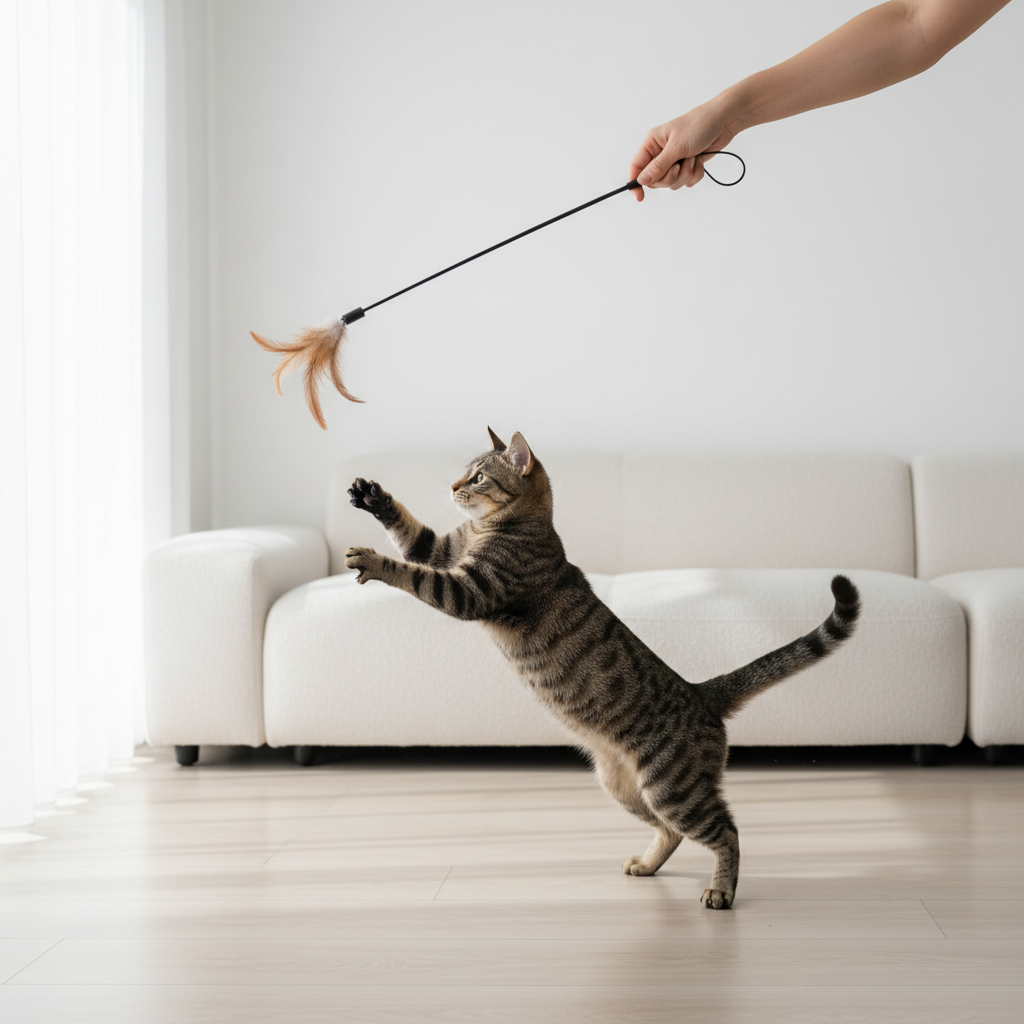
If your cat bites mostly at night or during “zoomies,” add a predictable play routine, a lot of households see improvement just by giving that energy a safer lane.
Hands-on training that actually reduces biting and scratching
This is the practical core. You’re teaching two things: what to do instead, and that gentle behavior keeps good stuff coming.
1) Stop using hands as toys, even “gently”
If hands have ever been a toy, your cat has a reason to keep trying. Switch to toys that move like prey but keep distance.
- Wand toy for chase and pounce
- Kick toy for bunny-kicking
- Treat ball or puzzle feeder for solo hunting
2) Teach “gentle play” with a clear consequence
The moment teeth or claws touch skin, end the fun. Not dramatically, just consistently.
- Freeze your hand, don’t yank away fast, that can trigger more chase.
- Say a calm marker like “too bad” or “ouch,” then stand up and step away for 10–30 seconds.
- Restart play with a toy, not your hand, if your cat re-engages politely.
Consistency beats intensity here. You’re building a simple rule: rough contact makes attention stop, gentle play keeps it going.
3) Reward calm contact and polite approaches
If you only react to biting, you miss the chance to reinforce what you want. Look for tiny “good moments.”
- Four paws on the floor while you walk by
- Sniffing your hand without grabbing
- Choosing a toy instead of your ankle
Mark with praise and toss a small treat or start a toy game, you’re teaching your cat that self-control pays.
4) Use a short reset for overstimulation bites
For petting-related bites, the fix is often shorter petting sessions and more choice.
- Pet 2–3 strokes, then pause.
- If your cat leans in, continue, if they turn away or stiffen, stop.
- Prefer head and cheek rubs over belly or full-body petting, many cats tolerate those better.
A simple plan by scenario (so you know what to do next)
If you’re trying to figure out how to train a cat not to bite, a one-size plan can feel vague. This table maps common situations to realistic next steps.
| Situation | What it often means | What to do today |
|---|---|---|
| Bites during play | Hands became prey | Switch to wand toy, end play on contact, reward toy focus |
| Bites during petting | Overstimulation or boundary | Short petting cycles, watch tail/ears, stop before escalation |
| Ambushes ankles | Boredom, hunting drive | Play twice daily, add puzzle feeders, block ambush spots briefly |
| Bites when picked up | Handling fear or pain | Stop forced lifts, train consent-based handling, consider vet check |
| Bites after seeing cats outside | Redirected aggression | Create buffer zone, reduce window access temporarily, redirect to toys |

Pick one scenario to focus on for a week. Mixing five strategies at once usually makes it hard to see what’s working.
Common mistakes that keep the biting going
Even caring owners accidentally reinforce biting. These are the big ones I see come up over and over.
- Using hands to wrestle, then being surprised when your cat “plays hard.”
- Punishing after the fact: your cat won’t connect it, and it can increase fear.
- Yelling or spraying water: it may stop behavior in the moment, but often raises stress and damages trust.
- Pulling away fast: fast movement can trigger a stronger chase bite.
- Skipping enrichment: without outlets, cats invent their own, and your ankles are convenient.
According to the American Society for the Prevention of Cruelty to Animals (ASPCA), punishment-based methods can create fear or anxiety, so most behavior guidance emphasizes redirection and positive reinforcement instead.
When to talk to a vet or a behavior professional
Some biting is beyond “normal training,” and waiting can make it harder to unwind. It’s reasonable to ask for help if any of these apply.
- Biting starts suddenly in an adult cat, or intensity jumps quickly
- You suspect pain: reluctance to jump, hiding, sensitivity to touch, bad breath, drooling
- Bites break skin, or your cat seems panicked and hard to calm
- There’s ongoing conflict with other pets at home
For bites that break skin, it’s usually wise to contact a healthcare professional, cat bites can become infected. On the cat side, your veterinarian can help rule out medical drivers, and a qualified cat behavior consultant can build a plan for fear, aggression, or multi-cat tension.
Key takeaways and a realistic next step
If you take one idea from this, let it be this: how to train a cat not to bite is mostly about prevention plus redirection, not winning a power struggle. Watch the early signals, keep hands out of play, and make gentle choices rewarding.
Action step: for the next 7 days, schedule two short play sessions daily with a wand toy, and end every session with a small treat or meal, many cats settle down when the hunt sequence feels “complete.” If biting still escalates or feels unpredictable, consider a vet check to rule out discomfort.